Top Mark Capital · 2026 Q2
Partner Letter
There Will Be Blood.
Dear Partners,
In the post large language model world, it is very easy to produce content. I’ve witnessed it personally and I’m sure you have as well. We value you and your time, so we are explicitly making our letters as brief as possible while also communicating everything that is important. Your feedback is greatly appreciated.
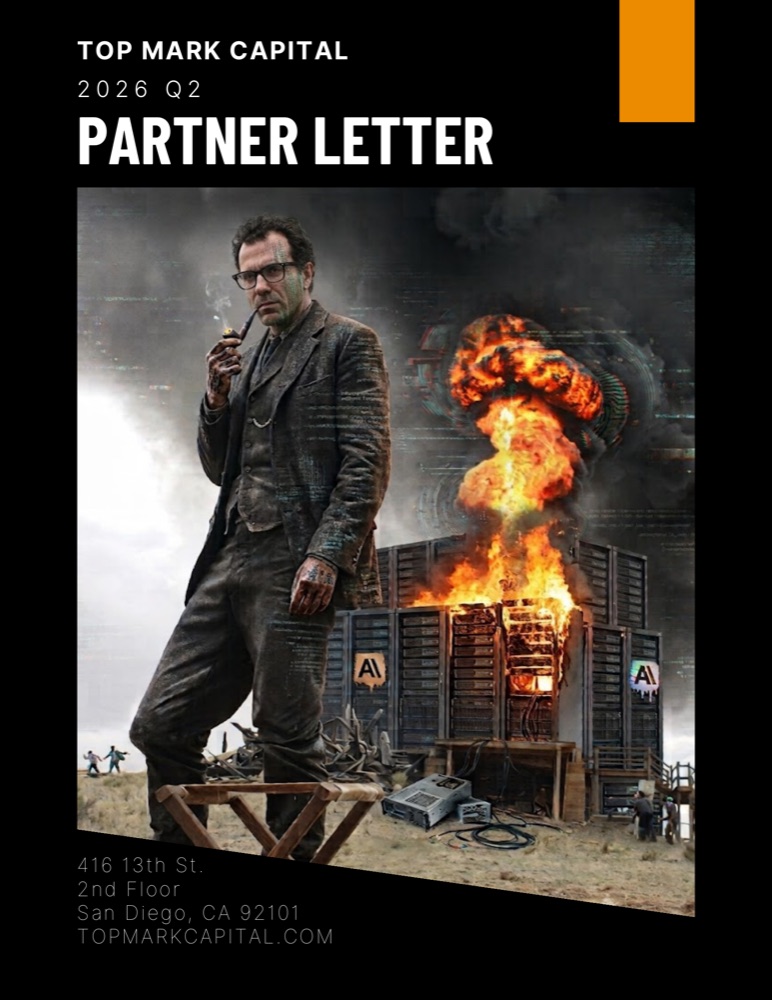
The cover image and the topic of this letter are inspired by an infamous scene from the 2007 film There Will Be Blood.1 But first, Anthropic’s quarter. While we do not yet have full Q2 data, the company reportedly added nearly the entire enterprise value of Illumina in revenue during the first two months.
Anthropic x OpenAI Run Rate Revenue
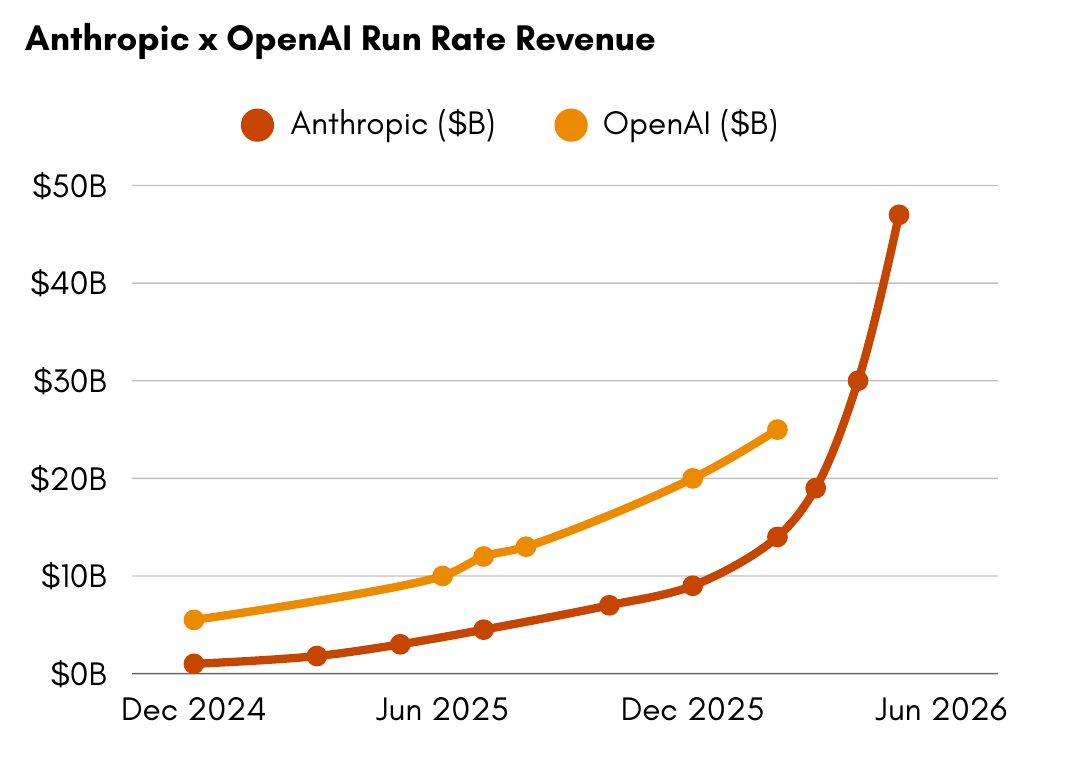
Annualized run-rate revenue, estimated, not GAAP. Source: Epoch AI, AI Companies Revenue Reports.2
Meanwhile, models are converging, if not commoditizing, so tech companies do what tech companies do: they differentiate. Differentiation for an AI lab means integrating models into the application layer, and Anthropic’s revenue is the reward for being first to take that leap.
Claude Code3 was a sharper version of an application its own partner Cursor had built on Anthropic’s models. Claude Cowork followed. Then Claude Design, pointed at Figma, Canva, and Adobe. Three days before Claude Design shipped, Anthropic’s chief product officer resigned from Figma’s board; Figma’s chief executive said Anthropic had not been consistently candid.4 That scene raised eyebrows among Anthropic’s customers.
What came next stood the hair up on the backs of their necks. With its mid-year Fable 5 model release, Anthropic began retaining usage data for thirty days even on plans that had promised zero data retention, on safety grounds, without a binding guarantee against training on it later.5
Near the end of the film that inspired our cover art, the oilman Daniel Plainview tells a rival that the oil beneath the man’s land is already gone. He explains drainage: if you have a milkshake, and I have a milkshake, and I have a straw, and my straw reaches across the room, then I drink your milkshake. I drink it up. He sank a well at the edge of his own land and drained the oil from beneath his neighbor.
The AI labs sit where Plainview sat. Absent a zero-data-retention policy, the straw takes up every request an enterprise sends a model, and far more when the work runs through an application-layer tool.
So the useful question for a concentrated, long-term investor is not whether a company “has a moat.” It is what the barrier is made of, and whether the straw weakens it or strengthens it.
Charlie Munger’s favorite mental model was invert, always invert. Invert for what gets stronger: which moats does the straw improve?
Quickly, a definition. I do not care much for the word moat, but a liquid fortress is apt given this straw. By moat we mean the collection of Powers that lets a business sustain economic returns above its cost of capital, over the long run. Helmer’s discipline is that a Power needs a benefit, which improves cash flow, and a barrier, which is why a well-funded rival does not simply copy you.6 The benefit shows up in the numbers; the barrier is the half most forget. So the better question is never whether a business has a moat. It is: what is the barrier made of?
That leads to a thought experiment. Write down the secret sauce: the processes, the patents, the org charts, the playbooks. Hand the file to the fiercest competitor. What was lost? Call it the drainage test. The straw drains knowledge. A barrier made of nothing but undisclosed knowledge is already gone. It was a secret, and a secret was never a moat.
The straw improves a barrier when better models raise the value of something only the owner has: private feedback, earned judgment, a process that generates ground truth a rival cannot rent.
For an investor, the scarce input used to be throughput: how much you could read and hold. That pool is draining. What becomes more valuable as intelligence commoditizes is taste: the felt sense of what is good before you can fully explain why. Taste cannot be prompted into existence. It is built through reps and through being wrong, inside a circle of competence you have earned, not one you have declared.
Financial firms have always dealt in intelligence, so they know intelligence alone is not a moat, it’s a prerequisite. Ken Griffin has argued that ‘calling the quarter’ is being competed away by alternative data and AI, and that what survives is vision about which companies change society over years, not quarters.7 That is taste. We agree.
One last inversion: what Power do the AI labs hold? Weights depreciate in months. The leaders climb the same curve and open weights are just months behind. The climb into applications isn’t the reward for seeing the future first. It is the only place a lab can go to manufacture a barrier. The reason Plainview is drinking your milkshake is that he doesn’t have one.
The labs know this, which is why the fight over distillation is so bitter: a rival can point its own straw at a frontier model’s interface, train on the answers, and walk off with much of the capability for a fraction of the original bill. They call it theft, but the “learning is transformative” defense used to train on the open internet is essentially the same argument. The drainer discovers he too can be drained.
We are at a fork in the road. One path will concentrate the value captured by artificial intelligence amongst a chosen few, while the other will democratize its value across society. We hope the latter wins out.
Our largest position by a wide margin, held across both TMCP and TMHP, is deliberately not an AI story. It is a specialty operator whose edge is its own and that the market is not chasing. That is much of the attraction. We added to that position in the teeth of the first-quarter drawdown8 because the price moved and the theses did not.
What would tell us we are genuinely wrong is not the price. It is the owner economics of these businesses breaking against our expectations. That is what we will report to you, and it is what to hold us to: not the quarterly mark, which tells you what the crowd is chasing this month, but whether the barriers we thought we owned still look like barriers a year from now under the drainage test. We may be wrong about how fast the drainage occurs. We do not want to be wrong about what kind of barrier we thought we owned. Put all your eggs in one basket, as Andrew Carnegie said, and then watch that basket.9
Our results reflect a deliberate process. Some investments may take five years or more, others may appreciate sooner. A rare few may be held indefinitely. Along the way, there will be adventures. Detours and damage alike. The question is never whether they will happen, but whether we bought right and whether we have the patience to continue on. We invest for outcomes measured in years, not quarters. In the near term, our results are as likely to be poor as strong. Over time, we believe our results will prove satisfactory.
If you share our temperament and long-term perspective, we invite you to consider joining us as a Partner.
Mike & Jason
References
- Cover image generated with Google’s Gemini from a simple prompt plus reference still: a parody in which Dario Amodei stands in for Daniel Day-Lewis’s Plainview. ↩
- “Anthropic x OpenAI Run Rate Revenue” chart. Figures are annualized revenue run-rates (a recent month or quarter annualized), are estimates, and are not GAAP full-year revenue; the two companies disclose on different bases and as of different dates, so the comparison is directional. Anthropic’s line runs through its ~$47B run-rate disclosed in late May 2026, up from roughly $9B at the end of 2025. OpenAI’s line ends at its last reported run-rate, ~$25B as of late February 2026 (The Information), a level that has held roughly flat since; OpenAI has not disclosed a more recent figure, which is why its line stops earlier than Anthropic’s. The body’s “added nearly the entire enterprise value of Illumina” compares Anthropic’s spring step-up (to ~$47B in May) against Illumina’s ~$28B enterprise value on June 30. Source: Epoch AI, AI Companies Revenue Reports (https://epoch.ai/data/ai_companies_revenue_reports.csv). ↩
- Anthropic up the stack. Claude Code (agentic coding harness); Claude Cowork (desktop agent for general computer work, early 2026); Claude Design (launched 17 April 2026 on Claude Opus 4.7; design / prototype / marketing tooling aimed at Figma, Canva, Adobe). Sources: Anthropic product announcements; TechCrunch (16 Apr 2026) on the concurrent board resignation; Stratechery. ↩
- The Figma / Krieger episode. Mike Krieger, Anthropic CPO (Instagram co-founder), resigned from Figma’s board on 14 April 2026, the same day The Information reported Anthropic’s next model would include design tools that could compete with Figma; Claude Design shipped 17 April. TechCrunch (Tim Fernholz, 16 Apr 2026): “Anthropic CPO leaves Figma’s board after reports he will offer a competing product,” techcrunch.com/2026/04/16/anthropic-cpo-leaves-figmas-board. Days later, at a private gathering of AI founders and investors, Figma CEO Dylan Field said Anthropic “were not consistently candid in their communications” (reported by Alex Konrad, Upstarts Media, 23 April 2026); in his subsequent Stratechery interview (25 June 2026) Field characterized the relationship only as “complicated.” Body states sequence and Field’s on-record characterization only. We do not assert any legal breach, fiduciary claim, or that Claude Design alone caused any stock move. ↩
- Data retention and the drainage mechanism. “Zero data retention” (ZDR) is the enterprise promise that a provider keeps none of a customer’s prompts or outputs after serving them. With its mid-2026 Fable 5 release, Anthropic changed its terms to retain usage data for thirty days even on plans that had promised zero retention, citing safety; it said it would not train on that data but added no binding safeguard against doing so later. Our claim in the text is structural, not an assertion that any lab trains on a specific customer’s data: serving the request, and the model improving in general, is enough to drain a shared edge. Sources: Stratechery, “Anthropic’s Safety Superpower” (15 June 2026) and “Muse Image, Grok 4.5, Alex Karp on CNBC” (9 July 2026). ↩
- 7 Powers. Hamilton Helmer, 7 Powers: The Foundations of Business Strategy (Deep Strategy LLC, 2016). Power requires both a benefit (improves cash flow) and a barrier (a reason a rational, well-capitalized competitor will not arbitrage it away); the seven are scale economies, network economies, counter-positioning, switching costs, branding, cornered resource, and process power. The drainage test is our formulation, not Helmer’s: a screen for whether a barrier is made of knowledge a model can substitute for. ↩
- Griffin on the long horizon. Ken Griffin, Goldman Sachs “Great Investors” conversation with Raj Mahajan, recorded at the Goldman Sachs APEX symposium, 2 June 2026 (YouTube: youtube.com/watch?v=gZweef8LX7M). Notably, Griffin’s firm, Citadel, is one of the top multistrat firms that specialize in ‘calling the quarter’. ↩
- The Q1 add. In the depth of the first-quarter drawdown, across several fills in March 2026, TMCP added to the largest position. ↩
- Watch that basket. “Put all your eggs in one basket, and then watch that basket”: Andrew Carnegie, address to Curry Commercial College, Pittsburgh, 23 June 1885. ↩
The complete letter
This is the letter we shared with our partners. The complete version, with both partnership performance pages for Top Mark Capital Partners (TMCP) and Top Mark Health Partners (TMHP) and full disclosures, is available to accredited investors on request.
Request the complete letter →Considering becoming a Partner?
Our next contribution window opens October 1. We add Partners slowly, through shared thinking with people who invest on the same timescale we do.
Top Mark Capital Partners and Top Mark Health Partners are offered only to investors who are both accredited and qualified clients, a higher standard that applies because the partnerships charge a performance fee. We take reasonable steps to verify accredited status before any investment.
Start a conversation
This letter is published by Top Mark Capital as an advertisement and a solicitation of interest in a private offering conducted under Rule 506(c) of Regulation D, intended only for accredited investors who are also qualified clients (a higher standard that applies because the partnerships charge a performance fee). Top Mark Capital Partners (TMCP) and Top Mark Health Partners (TMHP) are offered solely through definitive offering documents and only after the firm takes reasonable steps to verify accredited status; no subscription will be accepted prior to completion of that verification. This letter reflects the authors’ views as of the date of publication, is not personalized investment advice, and is not an offer or sale in any jurisdiction where such offer or sale would be unlawful. Any companies mentioned are discussed to illustrate our process and market views; they are not recommendations to buy or sell any security, and the firm and its partners may hold positions in them. Registration with the SEC does not imply a certain level of skill or training. See topmarkcapital.com/terms.
Top Mark Capital Management, 416 13th St, 2nd Floor, San Diego, CA 92101 · (646) 470-3016